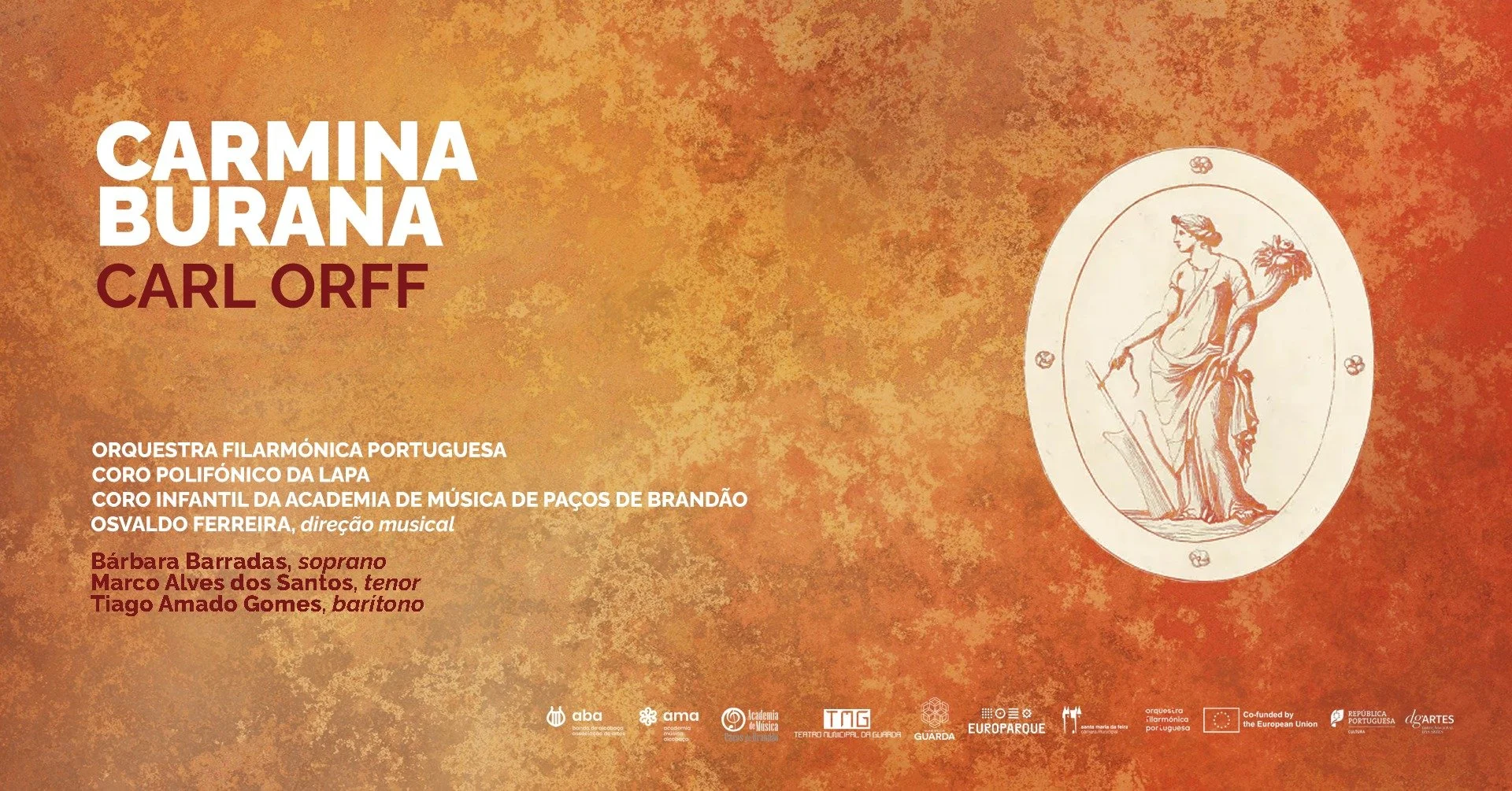
Bárbara Barradas, soprano
Marco Alves dos Santos, tenor
Tiago Amado Gomes, barítono
Lapa Polyphonic Choir
Lisboa Cantat Symphonic Choir
Portuguese Philharmonic Orchestra
Osvaldo Ferreira, conductor
Dates:
May 7th - Europarque, S. M. Feira - 21h00
May 9th - Guarda Municipal Theatre - 17h00
May 10th - Olga Cadaval, Sintra - 18h00
May 16th - Lagoa, Algarve - 18h00
May 17th - Aula Magna, Lisbon - 17h00
Program Notes:
Carl Orff’s Carmina Burana is a theatrical cantata composed in 1935–36, based on a collection of medieval poems discovered in the early 19th century. Scored for large orchestra, chorus, children’s choir, and soloists, it is organized into a prologue, three main sections, and a closing movement, with texts covering fortune, spring, love, and the pleasures of life. The work’s most famous movement, “O Fortuna,” frames the piece with a stormy, rhythm-driven choral outburst that has become a ubiquitous cultural touchstone. Orff’s approach emphasizes rhythmic vitality, clear melodic motifs, and declamatory vocal writing rather than dense contrapuntal textures, producing an immediate, visceral impact.
Orff conceived Carmina Burana as part of his larger pedagogical and theatrical project, integrating music with movement and speech in a way that revived ancient and medieval dramatic impulses for modern audiences. The harmonic language is relatively straightforward, often modal or diatonic, while the orchestration favors percussion and strong rhythmic punctuation to propel the drama. Critics and audiences have disagreed about the work’s artistic depth and historical associations, but its directness, powerful sonorities, and ritualistic energy have secured its place in the concert repertoire and popular imagination.